

Salar de Uyuni: When can you see the mirror effect?

Walking on clouds is not a fictional dream; it's a physical reality that occurs every year on the Bolivian altiplano . The Salar de Uyuni , the world's largest and highest salt flat , offers one of nature's most surreal spectacles: the mirror effect .
If you're planning your next adventure and looking for that perfect photograph , here's everything you need to know to capture the magic in all its splendor.
What exactly is the mirror effect?
The mirror effect is an optical and physical phenomenon that transforms the 10,582 square kilometers of salt crust into a gigantic natural reflector .
When a thin layer of water covers the white surface of the salt , it becomes almost perfectly smooth at a microscopic level, allowing sunlight (or starlight ) to reflect off it with amazing clarity .

Why and how does it happen?
Scientifically, the process is fascinating. The salt flat is a plain with minimal slope (less than one meter across its entire area). During the rainy season , water accumulates on the surface because the salt is impermeable in its densest layers.
With nowhere to drain, the water stagnates, forming a " film " only a few centimeters deep.
This layer of water acts like a mirror due to specular reflection . Because it is such a flat and extensive surface , there are no distortions, creating the illusion that the viewer is suspended in the air, surrounded by clouds above and below.

When can you see the mirror effect in the Salar de Uyuni?
To witness this visual miracle , timing is everything. The weather on the high plateau dictates the rules of the game.
- The ideal season: The mirror effect occurs during the austral summer , specifically between the months of January, February and March , extending until the beginning of April .
- February is the peak month: It's the period with the highest probability of constant rain . This is when the salt flats are usually most flooded , guaranteeing reflections across vast areas.
- Transition months (December and April): In December , the rains have barely begun, so the lake is only partially covered. In April , the water begins to evaporate, leaving mixed areas where you can see both the famous dry salt hexagons and small residual pools of water .

Although the effect is visible throughout the day, there are three " sacred " moments:
- Dawn: The soft light and pastel tones create an atmosphere of absolute peace .
- Sunset: It's the peak of drama . The skies turn orange, purple, and red , doubling their intensity as they reflect off the ground .
- The night: If you travel during the new moon in February , you can see the Milky Way below you. It's one of the most breathtaking astrophotography experiences on the planet.
Adventure in San Pedro de Atacama and the Salar de Uyuni (8 days / 7 nights)
How to get to the Salar de Uyuni from Chile
Chile is one of the main starting points for international travelers who wish to cross the border into this Bolivian wonder .
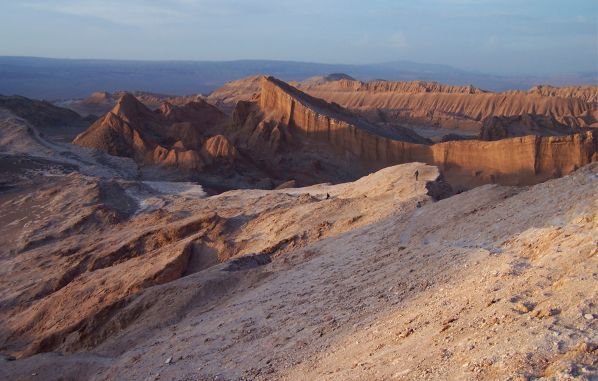
- From San Pedro de Atacama: This is the most popular and scenic route . Many agencies offer 3- or 4-day tours departing from the Chilean desert . You'll cross the Hito Cajón border crossing and not only reach the Salar de Atacama; before that, you'll pass through the Eduardo Abaroa Andean Fauna National Reserve , where you'll see Laguna Colorada , Laguna Verde , and the Sol de Mañana geysers .
- From Calama or Santiago: By bus , from Calama , you can take direct buses to the city of Uyuni (Bolivia) . The trip takes approximately 8 hours , passing through Ollagüe . By plane , the fastest option from Santiago is to fly to La Paz and then take a 45-minute domestic flight to Joya Andina Airport in Uyuni .

Traveler's Tips
Visiting the Salar de Uyuni during the rainy season requires special preparation . Don't forget to pack these items :
- Waterproof footwear: Rain boots (or rubber boots ) are essential . Walking through salt water in cloth shoes will ruin your footwear and can irritate your skin .
- Extreme sun protection: Water reflection doubles UV radiation . Use high-SPF sunscreen , a hat , and sunglasses with UV protection .
- Layered clothing: Even though it's summer , the altitude (3,650 meters above sea level) causes temperatures to drop drastically after sunset .
- Take care with your camera: Salt water is highly corrosive . Clean your equipment after each session and prevent water from touching the electronic components .

More than just a social media trend , the Salar de Uyuni is a reminder of the beauty of our planet . Get your camera ready, but above all, prepare your senses . In the mirror of Uyuni , the most important reflection you'll find will be that of your own capacity for wonder .
You might also be interested in: 10 Instagrammable places in Cusco and Machu Picchu